
Station 16 Geologiepfad Malbun: Im Schlucher kommt alles zusammen
No difficulty information available.
Media


tour_infos_headline
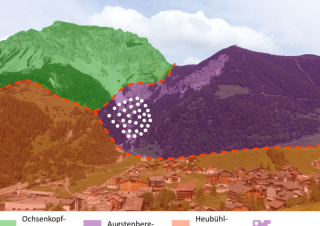
In the Schlucher, the Augstenberg-Schuppe, the Ochsenkopf-Scholle and the Heubühl-Schönberg-Scholle meet. The Augstenberg scale was pressed against the other two floes from the southeast. In the process, the gypsum layers were pressed together to form a thick mass. When plaster gets wet, it crumbles and becomes deformable. The gypsum mass in the Schlucher therefore slowly creeps down the valley. In addition, new debris from the rocks of the Gamsgrat is constantly falling on it. In addition, there are clayey deep-sea sediments in the Schlucher. If it rains heavily, this mixture could cause mudslides and debris avalanches and threaten the settlement.
Info:
The geological timeline
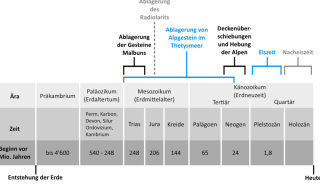
The landscape of the present is the result of millions of years of history. Their various events can be assigned to the epochs of the geological chronology. The deposition of rocks in the Tethys Sea occurred in the Triassic in the Mesozoic. The elevation of the seabed to the mountains took place in the Tertiary, in the Cenozoic period. The most recent forms of mountain peaks and ridges as well as scree slopes, gorges and valleys with their moraine cover are the product of the Quaternary. In other places in the Alps – including Liechtenstein – there are rocks that date back to the Palaeozoic. They bear witness to the fact that long before the Tethys Sea and before the Alps, there was already a mountain range here. This has long since disappeared. This will also happen to the Alps one day.
tour_infos_headline
Directions
No description available.
Entry updated on: 28.04.26, 02:02
Fehler melden (ID: tou_s9t_ujbvjcjc-adur-ehcu-rctd-crgujdihfctb)


