
Station 13 Geologiepfad Malbun: Warum gibt es Quellen?
No difficulty information available.
Media


tour_infos_headline
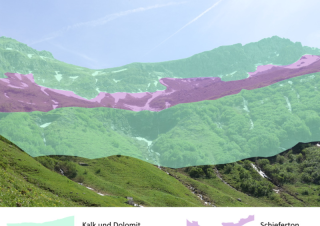
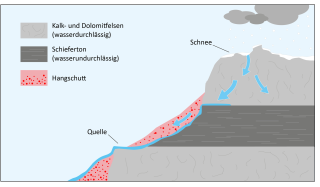
Under the scree slopes and grass-covered steep slopes above the Wasserkopf there is slate clay. Rainwater can penetrate into numerous cracks in the limestone and dolomite of the summit region and finally hits the barely permeable shale clay below. Rainwater that falls on the grass-covered scree slope also seeps down to this impermeable layer. Where the layer reaches the surface. There, the rainwater emerges as spring water.
Info:
The water cycle, sea salt and gypsum in Malbun
Water is in an eternal cycle. The rainwater that falls in Malbun evaporated from the Atlantic a few days ago and was transported to Europe as water vapor with the westerly wind current. On weather fronts and on mountain slopes, clouds form from the water vapour. The former seawater falls onto the land as fresh water and finally flows back into the sea. In the process, it dissolves substances from the rock and contributes to the erosion of the mountains through so-called chemical weathering. When evaporated, these substances remain in the sea as salt. Therefore, seawater is salty. Under special conditions, a lot of water can evaporate in a marine area and salt crusts form. This is how the gypsum rocks that we encounter in the area around Lake Sass were formed.
tour_infos_headline
Directions
No description available.
Entry updated on: 28.04.26, 05:07
Fehler melden (ID: tou_s9t_gabuvvie-vtru-eqvg-iqrb-jucivjjbiqhe)


