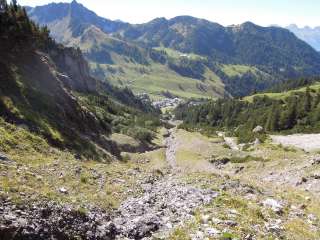
Station 2 Geologiepfad Malbun: Eine Naturgefahr lauert im Schlucher

In the Schlucher sits a dangerous mass of rubble. It consists of the resident gypsum rock and the scree that falls down from the Gamsgrat. In heavy rain, the gypsum absorbs the water like a sponge and becomes mobile. In earlier years, the entire debris mass crawled at speeds of over one meter per year and there was a danger that it could destroy the surrounding houses as a sudden avalanche of rocks. Today, water drains and safety dams protect the church and all the houses in the area.
Info:
Natural hazards in Liechtenstein
Most natural hazards in Liechtenstein are the result of natural processes. On the mountain slopes, the erosion of the mountains can be seen in the form of ruts, mud flows, rockfalls and torrents. In winter, avalanches can be added. In the valley, there is a risk of flooding by the Rhine. These processes existed long before people were here and they will continue to exist afterwards. They only become a danger when humans and their settlements and transport routes dare to get too close to them. In addition to these "exogenous" natural hazards caused by external forces, there is also an invisible and rarely noticeable danger from the earth's interior. Earthquakes are an "endogenous" natural hazard. Their dangerousness should not be underestimated here either. They occur rarely and without warning and can also cause damage in Liechtenstein. With every earthquake, whether strong or weak, the mountain covers move a little and the Alps continue to grow, on average just under one millimetre per year. At the same time, they are removed by exogenous processes by about the same amount.

Entry updated on: 28.04.26, 02:39
Fehler melden (ID: tou_s9t_rqcfgath-ffbq-efgd-iuic-ugesgcfihcjg)