Station 14 Geologiepfad Malbun: Die Tektonik Malbuns

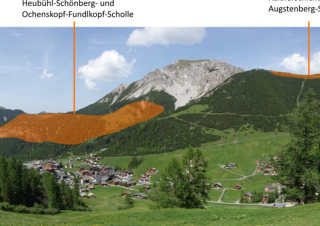
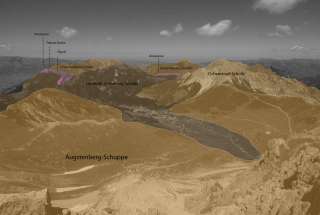
Today, we encounter rocks of the same age in Malbun at very different heights. On the Augstenberg, the youngest rocks (gypsum and main dolomite) are only found at summit heights around 2200 m. At the foot of the mountain, the oldest rocks come to light (shell limestone). The situation is completely different at the Ochsenkopf. Here the main dolomite builds up almost the entire massif and at the foot are the gypsums. Everything is much lower down here. The Eastern Alpine blanket has broken into various floes. These are shifted vertically against each other. The Augstenberg is part of a floe. The Ochsenkopf is part of another floe, which is offset downwards opposite the Augstenberg-Scholl.
Info:
Tectonic movements bring together what does not belong together
The field that deals with the spatial displacement and location of rock packages is called tectonics. The view from Augstenberg to the north shows the tectonic units. At the floe boundaries, rocks come to light that were formed at completely different times and in other marine areas. They were dragged along during the overthrust at the time of mountain formation at the bottom of the Eastern Alpine Blanket. When the Eastern Alpine blanket broke into floes and these shifted vertically, these rocks appeared at the floe edges. One of them is the radiolarite, which we find in the bed of the Schlucherbach. It is a rock of the deep sea and was probably formed during the Jurassic period. It has nothing in common with the rocks of the shallow southern Tethys Sea of the Triassic and yet occurs right next to it in today's landscape.


Entry updated on: 28.04.26, 02:01
Fehler melden (ID: tou_s9t_uetfqfqa-uutv-ejfc-rbtt-dasifbvsjgig)