Station 11 Geologiepfad Malbun: Eiszeitliche und nacheiszeitliche Talformung

A V-valley is sawn into the Ice Age U-valley after the Ice Age
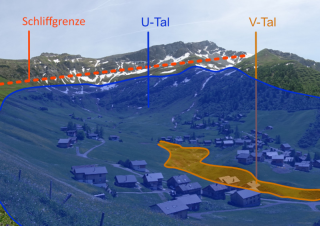
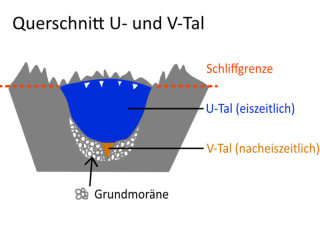
When looking into the Malbuntal, two very different valley shapes are recognizable, both of which were created by the work of water. The valley basin of Malbun and the individual side valleys, such as the Vaduz valley and the mountain valley, have the shape of rounded bowls. In cross-section, this shape is reminiscent of the letter "U". Therefore, such valley forms are called U-valleys. Glaciers need hundreds of thousands of years to carve out such a valley. In the middle of the valley, the Malbunbach flows in a sharp V-shaped incision. Such a V-valley is created when a stream saws into the landscape. The V-Valley, where the stream flows today, was formed after the glacier melted. The shape was created after the Ice Age and is only a few thousand years old.
Info:
Ice and water are softer than stone and yet form valleys
How can water grind out valleys of solid rock? Strictly speaking, neither a glacier nor a stream grinds down rocks. But both carry debris with them. Glaciers the size of the Malbuntal Glacier flow about 10 cm per day. In doing so, they pull the scree and fine sand on their soles. This rock mixture is called ground moraine. By grinding down the landscape along its entire base, a glacier forms a wide U-valley. A flowing torrent also sweeps away debris in its stream bed. This saws the landscape along a line like a V. The small V-valley of the Malbunbach has not yet been cut into the rocky subsoil, but only into the ground moraine of the former glacier, which covers the entire valley floor.


Entry updated on: 28.04.26, 01:33
Fehler melden (ID: tou_s9t_tjrrgtab-huqe-edai-qaer-ijteertbggje)