Station 1 Geologiepfad Malbun: Meeresgrund, wo man hinblickt

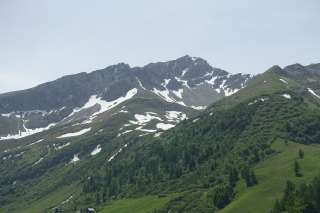
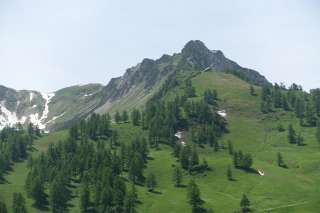
All rocks around the valley basin consist of sedimentary rocks. They were once soft mud at the bottom of a sea. The mud consisted of remnants of small marine life and fine dust and suspended matter that floated in the water and deposited and hardened over time. The sedimentary rocks limestone, dolomite, gypsum and rough wacke weather differently. This is evident in the rock shapes. The limestones of the Augstenberg build solid and steep rock faces. The dolomites of the Gamsgrat crumble more easily than limestone and form jagged rock faces under which large scree slopes lie. The gypsum and roughage under the Gamsgrat disintegrate even more easily. All that remains are the bizarre rock towers, which are slowly crumbling.
Info:
Formation of limestone, dolomite, gypsum and rough wacke
Most of the earth's limestones are biogenic rocks. They consist largely of debris from the calcareous shells of marine life. Often these are very small and can only be detected under the microscope. Dolomite is an altered limestone. It is formed from lime sludge, which is exposed to strong evaporation in very shallow water. Dolomite is thus a witness to a time when the climate was very different from what it is here today. Gypsum is also the result of strong evaporation. It is not biogenic, like lime, but an evaporative rock, a so-called evaporite. Like salt, it is separated from the water during intensive evaporation. In Rauwacken, gypsum, dolomite and lime are mixed into a coarse mixture. Since the various components weather to varying degrees, roughwacke acquires the characteristic rough, holey surface that gives it its name. Strong evaporation prevails in the geological era called the Triassic about 220 million years ago. At that time, where the Alps are today, there was a shallow and shallow sea under a desert sky.


Entry updated on: 28.04.26, 05:37
Fehler melden (ID: tou_s9t_ejbqdust-ifvb-eivg-jsvj-eiqhiffghudt)