Kloster Grimmenstein

exclave
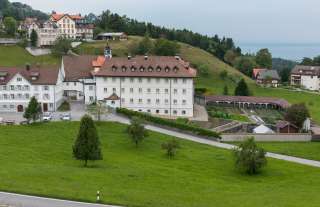
The Grimmenstein Monastery lies in a hollow on the northeastern slope, below the St. Margrethen - Heiden fork in the road.
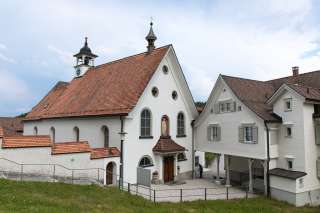
The monastery church presents itself as a typical work of order architecture with a nave and a low long choir section under gable roofs. The main decoration of the church is the three cartilage style altars from 1672. The tabernacle, which was purchased from Marbach in 1858, was built around 1730. On the left choir wall there is a high baroque cross group from around 1700. It has 141 seats and a gallery. Own monastery pharmacy.
History
In 1424, the Forest Sisters moved into the farmstead in Grimmenstein and were allowed to build their own house chapel on 4 July 1496. In 1549, the monastery burned down and was rebuilt in 1558. In 1612, the enlarged chapel was consecrated. In 1669, sisters bought building materials for a new church, which was consecrated in 1671. During the renovation of the church in 1822, the interior was raised and the portal enlarged. In 1858, the altars were renovated. In 1883, Appenzell Ausserrhoden allowed the church to be extended by five shoes to the west.
In 1922, church painter Joseph Traub freshened up the altars and the decoration of the church. The compromise solution worked out by architect Albert Bayer in 1955 changed the spatial structure of the church decisively. The dividing wall between the outer and inner choir was demolished and the choir arch narrowed. The new altar house was given a flat wooden ceiling instead of the vault. In 1956, the glass windows and altars were renovated. In 1998, the fourth interior renovation was carried out by the architects Faist and Vorburger, advised by the Federal Commission for the Preservation of Monuments.
| open | The monastery is open during the day |
| District | Oberegg, exclave |
| Owner | Convent of St. Ottilia Grimmenstein, Walzenhausen |
| Special features | The home remedies are made according to tried and tested recipes and sold in the monastery's own shop |


Address


Entry updated on: 03.10.26, 02:36
Fehler melden (ID: civ_s9t_svjqabjs-buag-eerc-ibjq-tjacfuqcbeth)